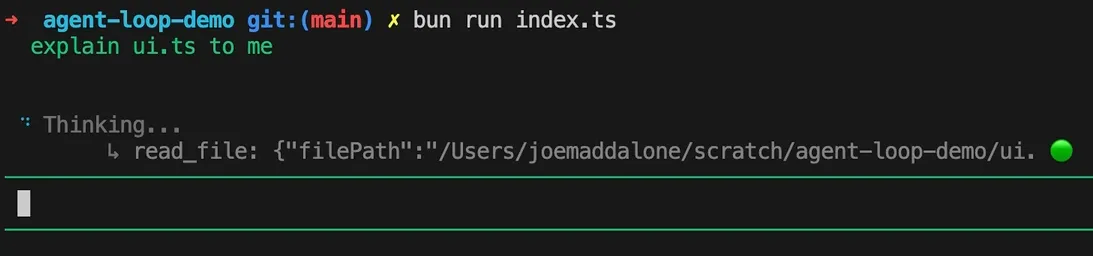
Transform your basic terminal interactions into a polished, developer-friendly CLI with real-time feedback and markdown formatting. This tutorial solves the pain of unstructured output and invisible AI processing by introducing a robust terminal UI (TUI) built with pi-tui and chalk. Perfect for building local AI agents, CLI tools, or any terminal application requiring clear state visibility and rich text rendering.
import {  TUI,  ProcessTerminal,  Editor,  matchesKey,  Key,  visibleWidth,  truncateToWidth,  Markdown,  Loader,} from "@mariozechner/pi-tui";import type { Component } from "@mariozechner/pi-tui";import type { ModelMessage } from "ai";import chalk from "chalk";import type { MarkdownTheme } from "@mariozechner/pi-tui";
export const uiTheme = {  borderColor: chalk.green,  selectList: {    selectedPrefix: (s: string) => chalk.cyan.bold(s),    selectedText: chalk.cyan,    description: chalk.gray,    scrollInfo: chalk.gray,    noMatch: chalk.red,  },};
export const mdTheme: MarkdownTheme = {  heading: (s) => chalk.bold.cyan(s),  link: (s) => chalk.blue(s),  linkUrl: (s) => chalk.dim(s),  code: (s) => chalk.yellow(s),  codeBlock: (s) => chalk.green(s),  codeBlockBorder: (s) => chalk.dim(s),  quote: (s) => chalk.italic(s),  quoteBorder: (s) => chalk.dim(s),  hr: (s) => chalk.dim(s),  listBullet: (s) => chalk.cyan(s),  bold: (s) => chalk.bold(s),  italic: (s) => chalk.italic(s),  strikethrough: (s) => chalk.strikethrough(s),  underline: (s) => chalk.underline(s),};
export class AgentUI implements Component {  private tui = new TUI(new ProcessTerminal());  private editor = new Editor(this.tui, uiTheme, { paddingX: 1 });  private thinkingLoader: Loader | null = null;  private currentAction = "";  private mdCache = new Map<ModelMessage, Markdown>();
  onInput?: (text: string) => Promise<void>;
  constructor(private history: ModelMessage[]) {    this.tui.addChild(this);    this.tui.addChild(this.editor);
    this.editor.onSubmit = (text) => {      if (this.thinkingLoader) return;      if (text.trim()) this.onInput?.(text);    };
    this.tui.addInputListener((d) => {      if (matchesKey(d, Key.ctrl("c"))) this.exit();      return undefined;    });
    process.on("SIGINT", () => this.exit()).on("SIGTERM", () => this.exit());  }
  start() {    this.tui.start();    this.editor.focused = true;    this.tui.setFocus(this.editor);  }
  exit() {    this.tui.stop();    process.exit(0);  }
  appendSpacer(lines: string[]) {    if (lines.length > 0) lines.push("");  }
  colorMessage(m: ModelMessage) {    return m.role === "user" ? chalk.green : chalk.white;  }
  renderAssistantMessage(m: ModelMessage, w: number) {    let md = this.mdCache.get(m);    if (!md) {      md = new Markdown(this.getMessageText(m), 2, 0, mdTheme);      this.mdCache.set(m, md);    }    return md.render(w);  }
  renderPlainMessage(m: ModelMessage) {    const message = this.getMessageText(m);    return message      .split("\n")      .map((l) => `  ${this.colorMessage(m)(l)}`);  }
  renderMessage(m: ModelMessage, w: number) {    return m.role === "assistant"      ? this.renderAssistantMessage(m, w)      : this.renderPlainMessage(m);  }
  appendThinking(lines: string[], w: number) {    if (!this.thinkingLoader) return;    this.appendSpacer(lines);    lines.push(...this.thinkingLoader.render(w));    if (this.currentAction) {      lines.push(`\t${chalk.dim("↳")} ${chalk.gray(this.currentAction)}`);    }  }
  fitWidth(lines: string[], w: number) {    return lines.map((l) => (visibleWidth(l) > w ? truncateToWidth(l, w) : l));  }
  getMessageText(m: ModelMessage): string {    if (typeof m.content === "string") return m.content;    return m.content.map((part) => ("text" in part ? part.text : "")).join("");  }
  push(m: ModelMessage) {    this.history.push(m);    this.tui.requestRender();    this.editor.setText("");  }
  setActionStatus(action: string) {    this.currentAction = action;    this.tui.requestRender();  }
  clearActionStatus() {    this.currentAction = "";  }
  makeSpinner() {    return new Loader(this.tui, chalk.cyan, chalk.dim, "Thinking...");  }
  invalidate() { }
  render(w: number) {    const lines: string[] = [];    for (const m of this.history) {      this.appendSpacer(lines);      lines.push(...this.renderMessage(m, w));    }    this.appendThinking(lines, w);    return this.fitWidth(lines, w);  }
  async think<T>(fn: () => Promise<T>) {    this.thinkingLoader = this.makeSpinner();    this.clearActionStatus();    try {      const reply = await fn();      this.thinkingLoader = null;      return reply;    } catch (e) {      this.thinkingLoader = null;      this.history.push({        role: "assistant",        content: `🔴 Error: ${e instanceof Error ? e.message : String(e)}`,      });    } finally {      this.clearActionStatus();    }  }}
Now let’s add the Ui to our Agent Loop
First import our Agent UI and remove readline
import { generateText, isLoopFinished } from "ai";import type { ModelMessage } from "ai";import * as readline from "readline";import { PARENT_TOOLS, } from "./tools";import { api, MODEL, WORKDIR } from "./config";import { api, CONTEXT_LIMIT, MODEL, WORKDIR } from "./config";import { autoCompact, estimateTokens, microCompact } from "./compact";import { AgentUI } from "./ui";Now we’ll replace the readline implementation withour new TUI.
/** INTERFACE */
const rl = readline.createInterface({  input: process.stdin,  output: process.stdout});const history: ModelMessage[] = [];
const prompt = (): void => {  rl.question(" input >> ", async (query) => {    history.push({ role: "user", content: query });    const reply = await agentLoop(history);    history.push({ role: "assistant", content: reply });    if (reply) console.log(reply);    console.log();    prompt();  });};
prompt();
const history: ModelMessage[] = [];const ui = new AgentUI(history);
ui.onInput = async (query) => {  ui.push({ role: "user", content: query });  const reply = await ui.think(() => agentLoop(history, ui));  if (reply) {    ui.push({ role: "assistant", content: reply });  }};
ui.start();
An now we just pass the Ui intour Agent Loop.
/** AGENT LOOP */const agentLoop = async (messages: ModelMessage[]): Promise<string> => {const agentLoop = async (messages: ModelMessage[], ui: AgentUI): Promise<string> => {  let stepsSinceTodo = 0;  microCompact(messages);  const estTokens = estimateTokens(messages);  if (estTokens > CONTEXT_LIMIT) {    /* compaction code here */  }  const { text } = await generateText({    model: api.chat(MODEL),    system: `...`,    messages,    tools: PARENT_TOOLS,    stopWhen: isLoopFinished(),    onStepFinish: ({ toolCalls }) => {    onStepFinish: ({ toolCalls, toolResults }) => {      const usedTodo = toolCalls.some((tc) => tc.toolName === "todo") ?? false;      stepsSinceTodo = usedTodo ? 0 : stepsSinceTodo + 1;      if (stepsSinceTodo >= 3) {        messages.push({          role: "user",          content: "<reminder>Updated your todos.</reminder>",        });      }
      const tc = toolCalls[0];        if (tc) {          const args = JSON.stringify(tc.input).slice(0, 60);          const out = toolResults[0]?.output;          const result = out          ? typeof out === "string" && out.startsWith("Error")              ? `🔴 ${out.slice(0, 50)}`              : "🟢"          : "";          ui.setActionStatus(`${tc.toolName}: ${args} ${result}`);        }    },  return text;};
Try it out! Our Agent now has a simple, but much improved terminal user interface.